

A handbag brand earns the word functional when it survives a specific job, not when it looks the part. Four questions settle most of it: what must it carry, how will it be worn, how secure is the closure, and does it work after hours. Ask those before you read a single brand name.
The order matters. A working day moves through laptop carry, the office, travel days, everyday errands and evening, so the sections below follow that sequence. Each occasion has its own binding constraint, and the constraint is rarely the one the marketing copy leads with.
Fit is the reason this matters. Coresight Research's survey of 100 apparel decision-makers found size and fit named by 53% of respondents as the top reason for online apparel returns, ahead of color at 16% and damage at 10% (Coresight Research, surveyed March 2023). A bag that misses on dimensions is a return waiting to happen.
What actually makes a functional handbag brand for laptop carry
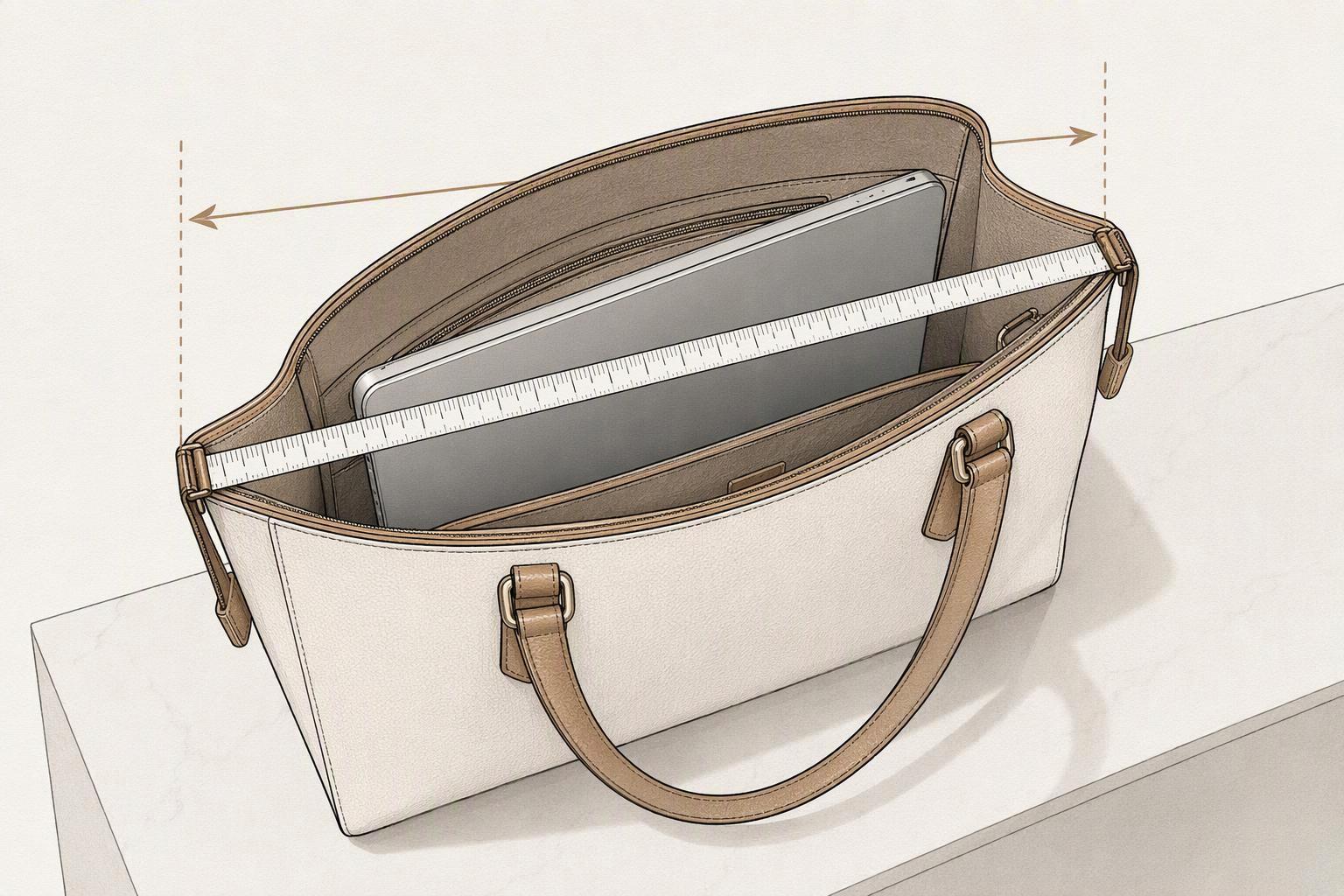
Laptop carry is decided by the device's physical body, not its screen label. Foley + Corinna's laptop fit checker states that bag openings and zips are often the binding constraint even when the interior is large enough (Foley + Corinna, 2026). A 14-inch MacBook Pro measures 12.31 inches wide by 8.71 inches deep by 0.61 inches high, while the 16-inch model runs 14.01 by 9.77 by 0.66 inches (Apple's published MacBook Pro dimensions). The 13-inch MacBook Air is 11.97 by 8.46 by 0.44 inches and the 15-inch is 13.40 by 9.35 by 0.45 inches (MacBook Air size and weight specs).
Which functional handbag brands get the office right
The 8am commute is where a work bag either holds its shape or does not. Coach's guide to handbags that fit your laptop advises matching the bag's laptop-sleeve size to the device and checking compartment layout rather than relying on silhouette alone (Coach, 2026). That is the whole test for this occasion: a published sleeve size, a padded compartment, and a closure you can trust on a crowded train.
Brands that publish a laptop-fit claim give you something to verify. The Club Bag states a fit of up to 15 inches in the main compartment and up to 13 inches in the bottom zipped compartment, with a magnetic closure, an empty weight of 3.2 lb, and body dimensions of 17.7 by 8.3 by 10.2 inches (the Club Bag's published laptop and dimension specs). Treat that as a brand-published claim, not a measured result, and check it against your own device body.
The trade-off is real. A structured leather tote with a padded compartment and a secure closure carries the weight and bulk that make it read as a work bag, so it rarely doubles as evening-appropriate. If you want one bag for the office and dinner, plan on a second, smaller option rather than a compromise tote.
Which functional handbag brands get travel right
Travel is governed by the carrier, not the bag. American Airlines publishes a personal item limit of 18 by 14 by 8 inches and a carry-on limit of 22 by 14 by 9 inches (American Airlines carry-on and personal item limits). JetBlue publishes 17 by 13 by 8 inches for a personal item and requires it to go beneath the seat in front (JetBlue's under-seat personal item size). Southwest's figure is 16.25 by 13.5 by 8 inches and United's is 17 by 10 by 9 inches (the 2026 airline-by-airline size chart, updated May 2026).
Delta is the exception worth knowing. Delta publishes no numeric personal-item size at all, only that the item must fit under the seat, alongside a carry-on cap of 45 linear inches with no dimension exceeding 22 by 14 by 9 inches (Delta's carry-on and personal item guidance). So the answer to "does my personal item need a number or just under-seat fit" depends entirely on which carrier you fly.
Which functional handbag brands get everyday carry right
Everyday carry is decided by weight and strap drop, and the errand-and-meeting day is where both show up. Brand-published empty weights for leather work totes sit around 1.3 to 2.4 lb, with Cuyana's Classic Easy Tote listed at 1.6 lb and its System Tote 16" at 2.3 lb (Cuyana's published tote weight and dimensions). MZ Wallace's Large Empire Tote is listed at 2.4 lb.
Heavier does not mean better made. A leather tote typically weighs between 0.6 and 1.2 kg empty against 0.3 to 0.7 kg for canvas, and the loaded-bag guidance is not to exceed 10% of your body weight, which is 5.5 kg for a 55 kg person (typical empty weights for leather versus canvas totes). That guide is vendor editorial and does not name the health source behind the 10% figure, so treat it as directional rather than clinical.
Strap drop needs to be scaled to your height, not chosen from a table. A crossbody drop that suits a 5'0" wearer does not suit a 6'0" one, and the ranges run from 18 to 20 inches at 5'0" to 5'3" up to 24 to 26 inches at 6'0" and above (how strap drop is measured and typical ranges). Measure your own comfortable drop before you shop.
Which functional handbag brands get evening right
Evening reverses the priorities: scale and closure first, capacity last. The test is whether the bag holds a phone, a card case and a key without a strap that fights your outfit, and whether the closure stays shut when the bag is set down. A compact frame bag with removable straps covers more of this than a fixed-strap clutch.
Verafied New York illustrates the pattern: 11.4 by 5.1 by 4.3 inches, 1.2 lb empty, a metal frame closure, and two sets of removable straps, an adjustable shoulder strap of 21.7 to 29.9 inches and a 10.6-inch top handle, giving three carry modes (the Éclair Bag's three carry modes). The Café Mini takes the smaller end at 7.48 by 3.54 by 2.76 inches and 0.44 lb, with a gold-tone zip closure and a 50.8-inch detachable strap (the Café Mini's zip closure and detachable crossbody strap). Neither carries a laptop claim, so neither belongs in the work section.
The trade-off at this occasion is capacity, and it is not negotiable. A bag small enough to read as evening wear will not hold a 13-inch laptop, a water bottle and a notebook, which is why the day-to-night bag is a real category problem rather than a marketing gap. If you need one bag that genuinely spans both, the removable-strap compact is the closest structure that exists, and it still asks you to leave the laptop behind.
How to judge any handbag yourself, and where Verafied New York fits
The framework travels to any brand. Pull the product page and check five things in order: the published body dimensions against your device body, the stated laptop-sleeve size if there is one, the closure type, the strap drop against your height, and the empty weight. If a brand publishes none of these, that absence is itself the answer.
The four-question checklist
What must it carry? Compare the device body to the published sleeve and opening dimensions.
How will it be worn? Match strap drop to your height and carry mode.
How secure is it? A zip or frame closure for travel and transit, magnetic for office days.
Does it work after hours? Check scale and strap removability, and accept the capacity trade-off.
How we apply this at Verafied New York, the publisher of this guide. Our Club Bag publishes its laptop fit — up to 15 in in the main compartment, 13 in in the bottom zipped one — which covers the step of checking a stated sleeve size against your device. That claim is our own, not an independent measurement, so still measure your device body and confirm the opening and zip yourself.
Frequently Asked Questions
Will a bag listed as fitting a 13-inch laptop fit my 14-inch MacBook Pro?
Only if the bag's own measurements say so. "13-inch" describes a screen, not a body, and the 14-inch MacBook Pro body is 12.31 by 8.71 by 0.61 inches (Apple's published MacBook Pro dimensions). Measure your device and compare it to the compartment's stated length, width and depth rather than to the laptop size on the product page. The opening is usually the tighter constraint: a zip or framed mouth can be narrower than the sleeve behind it, which is the failure mode Foley + Corinna flags in its fit guidance (Foley + Corinna).
Does my personal item need to meet a numeric size limit?
Not always, because the rule varies by carrier. American Airlines and JetBlue both publish numbers, at 18 by 14 by 8 inches and 17 by 13 by 8 inches respectively (American Airlines carry-on and personal item limits, JetBlue's under-seat personal item size), while Delta sets no numeric personal-item size and asks only that the bag fit under the seat (Delta's carry-on and personal item guidance).
Is a heavier handbag better made?
No. Empty weight reflects how much leather and hardware a bag carries, not how well it is put together. Leather totes commonly sit between 0.6 and 1.2 kg empty, against 0.3 to 0.7 kg for canvas (typical empty weights for leather versus canvas totes), and Cuyana's Classic Easy Tote is listed at 1.6 lb (Cuyana's published tote weight and dimensions). Treat the number as a comfort question: how long will you carry it, and does it stay reasonable against the 10%-of-body-weight guidance?
Can one handbag cover all four occasions?
Rarely, because the requirements pull against each other. Laptop carry needs a padded compartment and a closure that stays shut, and that bulk is exactly what makes a bag read as daytime. A compact frame bag cannot substitute: at 1.2 lb and 11.4 inches long, the Éclair Bag has no laptop claim at all, though its removable straps give it three carry modes (the Éclair Bag's three carry modes). The realistic single-bag answer is a compact design with detachable straps, which covers office through dinner but not the laptop.
What is strap drop, and why does it matter more than strap length?
Strap drop is the vertical distance from the top of the strap to the highest point of the bag body, so it tells you where the bag actually sits on you. Typical ranges run 4 to 6 inches for top-handle, 7 to 10 inches for shoulder and 18 to 24 inches for crossbody, with the crossbody range scaling by height from 18 to 20 inches at 5'0" to 5'3" up to 24 to 26 inches at 6'0" and above (how strap drop is measured and typical ranges). Total strap length is a different measurement and will not tell you where the bag lands.
Conclusion
Functionality is a set of measurements, not a brand attribute, and the four-question test is what turns a product page into a decision. Ask what the bag must carry, how it will be worn, how secure the closure is, and whether it works after hours, then check the published numbers that answer each one.
Expect trade-offs rather than a single answer. A structured laptop tote will not read as evening wear, a compact frame bag will not hold a 15-inch laptop, and a bag that clears American's 18-inch personal item limit may still be tight on JetBlue's 17 inches. Choosing by occasion means accepting which constraint you can live with.
Start with the occasion you carry most, apply the four questions, and let the published dimensions eliminate options before you fall for a finish. If you want to see the details in person, the Verafied's Brooklyn showroom offers styling appointments, and the collection pages list the same dimensions, weights and strap lengths used throughout this article.
About the Author
Verafied New York is a contemporary fashion brand based in Brooklyn, New York, known for elegant handbags and accessories that blend modern trends with timeless style. The brand's team wrote this guide to help shoppers judge a handbag by measurable details — dimensions, closures, strap drop, and empty weight — rather than marketing copy. You can explore the full collection and book a styling appointment at the brand's Dumbo showroom on verafiedny.com.
Leave a comment